Tuesday, April 9, 2013
"How To" Organic Gardening: CROP ROTATION, TSP PART 5
"How To" Organic Gardening: CROP ROTATION, TSP PART 5: CROP ROTATION FOR SOIL HEALTH WEBSITE: DIY ORGANIC GARDENING Most people see or know that your average farmer will plant a y...


CROP ROTATION, TSP PART 5
CROP
ROTATION FOR SOIL HEALTH
WEBSITE: DIY ORGANIC GARDENING
Most people see or know that your average farmer will plant a
year of corn in then a year or soybeans and then maybe rotate back to corm or
in some years grow sorghum. WHY?
The easiest way for any gardener/farmer/rancher to maintain
soil health is to rotate practices.
Weather that practice means rotating crops or rotating animals into and
out of pastures to maintain good healthy soil.
It is being proven through scientific studies that the healthier the
soil:
- the healthier the crop
- more vitamins
- tastier
- greater amounts of beneficial organism and bugs
- less pests and disease
- less erosion
- no more dust bowls
- top soil washing into streams
Many factors play into SOIL HEALTH. Sound conservation practices give us good
soil health.
THE KEY: What you take
out of the soil you MUST put back; and build on bringing MORE to the soil than
you take.
So what do I take out when I plant one thing and what do I
do to put it back? In terms of NOP this
would fall under the heading of:
§ 205.205 Crop rotation practice standard. http://www.ecfr.gov/cgi-bin/text-idx?c=ecfr&SID=d61cd233ec0207a30cc0ef08f4251018&rgn=div8&view=text&node=7:3.1.1.9.32.3.354.6&idno=7
The producer must implement a crop rotation including but not limited to sod, cover crops, green manure crops, and catch crops that provide the following functions that are applicable to the operation:(a) Maintain or improve soil organic matter content;
(b) Provide for pest management in annual and perennial crops;
(c) Manage deficient or excess plant nutrients; and
(d) Provide erosion control.
This
standard has several Guidance tools to achieve the CROP ROTATION GOALS.
We are
looking at:
- Compost and vermicompost in Organic Crop Production 5021
- Processed animal manure in Organic Crop Production 5006
- Allowance of green waste in Organic Crop Production 5016
Combined
with:
§ 205.203 Soil fertility and crop nutrient management practice standard.
(a) The producer must select and implement tillage and cultivation practices that maintain or improve the physical, chemical, and biological condition of soil and minimize soil erosion.(b) The producer must manage crop nutrients and soil fertility through rotations, cover crops, and the application of plant and animal materials.
(c) The producer must manage plant and animal materials to maintain or improve soil organic matter content in a manner that does not contribute to contamination of crops, soil, or water by plant nutrients, pathogenic organisms, heavy metals, or residues of prohibited substances. Animal and plant materials include:
(1) Raw animal manure, which must be composted unless it is:
(i) Applied to land used for a crop not intended for human consumption;
(ii) Incorporated into the soil not less than 120 days prior to the harvest of a product whose edible portion has direct contact with the soil surface or soil particles; or
(iii) Incorporated into the soil not less than 90 days prior to the harvest of a product whose edible portion does not have direct contact with the soil surface or soil particles;
(2) Composted plant and animal materials produced though a process that:
(i) Established an initial C:N ratio of between 25:1 and 40:1; and
(ii) Maintained a temperature of between 131 °F and 170 °F for 3 days using an in-vessel or static aerated pile system; or
(iii) Maintained a temperature of between 131 °F and 170 °F for 15 days using a windrow composting system, during which period, the materials must be turned a minimum of five times.
(3) Uncomposted plant materials.
(d) A producer may manage crop nutrients and soil fertility to maintain or improve soil organic matter content in a manner that does not contribute to contamination of crops, soil, or water by plant nutrients, pathogenic organisms, heavy metals, or residues of prohibited substances by applying:
(1) A crop nutrient or soil amendment included on the National List of synthetic substances allowed for use in organic crop production;
(2) A mined substance of low solubility;
(3) A mined substance of high solubility: Provided, That, the substance is used in compliance with the conditions established on the National List of nonsynthetic materials prohibited for crop production;
(4) Ash obtained from the burning of a plant or animal material, except as prohibited in paragraph (e) of this section: Provided, That, the material burned has not been treated or combined with a prohibited substance or the ash is not included on the National List of nonsynthetic substances prohibited for use in organic crop production; and
(5) A plant or animal material that has been chemically altered by a manufacturing process: Provided, That, the material is included on the National List of synthetic substances allowed for use in organic crop production established in § 205.601.
(e) The producer must not use:
(1) Any fertilizer or composted plant and animal material that contains a synthetic substance not included on the National List of synthetic substances allowed for use in organic crop production;
(2) Sewage sludge (biosolids) as defined in 40 CFR part 503; and (3) Burning as a means of disposal for crop residues produced on the operation: Except, That, burning may be used to suppress the spread of disease or to stimulate seed germination.
Basically both of these are saying that YOU the
gardener/farmer have to know your own soil, do your own soil tests and
continually test and document that testing as well as document the processes
you take.
Enough research has been done on
COVER CROPS to
determine the values of NPK that these crops
add to your soil.
Nutrient content of crops crop calculator you can check off the
crop you are planting and gain insight into how much NPK
will be removed at harvest.
As an example: corn is a heavy
feeder of Nitrogen so rotating in a crop after the harvest of legumes that
supplies heavy nitrogen is recommended.
For most small gardeners rotating
in a variety at different time will start to give you a balance of NPK
and other trace nutrients.
I have recreated a Chartpage that directs you to the chart you need.
I set up a tables to help with that planning. See next blog for additional examples and
table for rotating crops
Helpful websites
Monday, April 8, 2013
"How To" Organic Gardening: REPLANT SEEDLINGS, PART 4 TSP
"How To" Organic Gardening: REPLANT SEEDLINGS, PART 4 TSP: PLANTING SEEDS FOR SEEDLINGS OR STARTS WEBSITE: DIY ORG ANIC GARDEN The same NOP practice 205.204 Seeds and planting stock applies ...
Friday, April 5, 2013
REPLANT SEEDLINGS, PART 4 TSP
PLANTING SEEDS FOR SEEDLINGS OR STARTS
WEBSITE: DIY ORGANIC GARDEN

WEBSITE: DIY ORGANIC GARDEN
The same NOP practice 205.204 Seeds and planting stock
applies to starting seedlings . The soil must be
organic potting mix. The Miracle Grow
potting mix with additives can NOT be used
In 2011 I planted in paper tubes and made a video depicting the application of this method of Organic vegetable planters.
I used these paper tube planters seedlings and planted the
plants directly into the soil without removing the paper tubes; worked out
perfectly. In 2012 I decided to sell
seedlings at the Farmers Market and started by seedling inside under grow
lights. Spurred on by the “inside” mess
Jr finally constructed by greenhouse and it was ready for use by April
2012. I moved my inside plants to the
greenhouse in April. Spring started early
last year so I had some of the seedlings replanted before the greenhouse was
finished and they sat outside on the front stoop for about a month. This was not the best conditions for my
seedlings and some died.
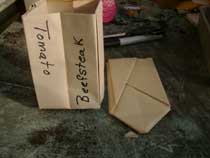
I replanted my seedlings into origami paper boxes made for
newsprint that measured approximately 1 ½ inches square and 3 ½ tall. My paper tube would fit inside the paper box
nicely so all my plants were transplanted into this next size planter. I discovered that these were not big enough
as my seedlings needed constant watering and did not seem to have enough “root”
space. This size was good for my own
garden as I could take them very easily to the garden without spilling and
potting soil and the buried very easily as compared to 2011 that was paper tube
only and often time the potting soil would become dislodged from the planter
which made for messier planting.
In 2012 when I discovered that I should have transplanted
into something larger I again replanted my seedling into a 2 ½ sq. by 4 inch
tall container which worked out very well for the Farmers Market, allowed the
plants to grow bigger and hardier and last longer than the smaller
containers.
This year in 2013 I am planting the tomatoes straight into
the bigger containers and all other plants like broccoli, brussel sprouts etc
into the 1 ½” squares. These sizes are
working out perfectly and so I have cut my replanting time by half and the
effort making paper boxes by more that half.
I also found a YouTube video on how to make seed tapes and this winter
put all my small seeds on seed tapes to help facilitate the planting.
See the video or written instructions for starting seedling in tubes. See video or written instructions for transplanting seedlings. To comply with NOP regulations use only organic potting MIX or use only potting
MIX with no additives. I use
Fertilome which is spaghmum peat moss with perlite. I discovered, too late that a better mix
would have been my Fertilome plus about 1/5 organic mulch, some calcium,
(gypsum), maybe some green sand and fish meal, bone meal or rock dust. I will try that next year. See complete instruction in the videos listed
or go to my web page for written instructions and pictures.
“The goal
is a well-drained, pathogen-free medium with sufficient fertility to give young
plants a strong start. Most recipes start with a base of compost, peat moss,
sand, perlite or vermiculite and then add smaller amounts of bone meal, blood meal,
alfalfa meal or greensand. Some growers also use lime or phosphate rock. “
Rodale Institute
See video for my greenhouse 2013 starts
Thursday, April 4, 2013
Replanting Seedlings-part four TSP
PLANTING SEEDS FOR SEEDLINGS OR STARTS
part four TSP
website: DIY Organic Garden look for the NOP series
The same NOP practice 205.204 Seeds and planting stock
that applies for buying seeds for crops applies to starting seedlings see SEEDS
for those details The soil must be
organic potting mix. The Miracle Grow
potting mix with additives should be avoided.
In 2011 I planted in
tubes and made a video depicting the application of this method.
I used these paper tube planters seedlings and planted the
plants directly into the soil without removing the paper tubes; worked out
perfectly. In 2012 I decided to sell
seedlings at the Farmers Market and started by seedling inside under grow
lights. Spurred on by the “inside” mess
Jr finally constructed by greenhouse and it was ready for use by April
2012. I moved my inside plants to the
greenhouse in April. Spring started
early last year so I had some of the seedlings replanted before the greenhouse
was finished and they sat outside on the front stoop for about a month. This was not the best conditions for my
seedlings and some died.
I replanted my seedlings into origami paper boxes made with newsprint that measured approximately 1 ½ inches square and 3 ½ tall. My paper tube would fit inside the paper box
nicely so all my plants were transplanted into this next size planter. I discovered that these were not big enough
as my seedlings needed constant watering and did not seem to have enough “root”
space. This size was good for my own
garden as I could take them very easily to the garden without spilling and
potting soil and the buried very easily as compared to 2011 that was paper tube
only and often time the potting soil would become dislodged from the planter
which made for messier planting.
In 2012 when I discovered that I should have transplanted
into something larger. In 2013 I again replanted my seedlings but this time into a 2 ½ sq. by 4 inch
tall container which worked out very well for the Farmers Market, allowed the
plants to grow bigger and hardier and last longer than the smaller containers.
This year in 2013 I am planting the tomatoes straight into
the bigger containers and all other plants like broccoli, brussel sprouts etc
into the 1 ½” squares. These sizes are
working out perfectly and so I have cut my replanting time by half and the
effort making paper boxes by more that half.
I also found a YouTube video on how to make seed tapes and this winter
put all my small seeds on seed tapes to help facilitate the planting.
See the video above for starting seedling in tubes. Use only organic potting MIX or use only potting
MIX with no additives. I use
Fertilome which is spaghmum peat moss with perlite. I discovered, too late that a better mix
would have been my Fertilome plus about 1/5 organic mulch, some calcium,
(gypsum), maybe some green sand and fish meal, bone meal or rock dust. I will try that next year.
“The goal
is a well-drained, pathogen-free medium with sufficient fertility to give young
plants a strong start. Most recipes start with a base of compost, peat moss,
sand, perlite or vermiculite and then add smaller amounts of bone meal, blood
meal, alfalfa meal or greensand. Some growers also use lime or phosphate rock.
“ Rodale Institute.
See complete instruction in the new video Replanting
or go to my web page for written instructions and pictures. NOTE: everything must be organic, organic seeds, organic potting mix however you may start your plant in the plastic containers easily purchased at Nurseries but they must be sterilized each year to prevent spreading diseases. I like paper containers, just bury as part of YOUR Organic plan.
Wednesday, April 3, 2013
"How To" Organic Gardening: Farmers Market Plant Seedlings
"How To" Organic Gardening: Farmers Market Plant Seedlings: REPLANTING SEEDLINGS FARMERS MARKETS OR GARDEN PLANTING W ebsite: DIY Organic Garde n Once seeds start coming up you can save them...
Farmers Market Plant Seedlings
REPLANTING SEEDLINGS
FARMERS MARKETS OR GARDEN PLANTING
Website: DIY Organic GardenOnce seeds start coming up you can save them the way they are in the paper tubes and transfer to a pan to take to your garden or you can replant them in another type of container to continue to grow. See REPLANTING SEEDLING FOR FARMERS MARKET video.

Newsprint is light and I wanted a heavier construction for the planter so it would hold up with all the handling I would be doing and all the watering.
Look closely at the picture and you will see the very tip of the flat box cut off. This creates a hole for water drainage. Although water will seep through the paper I gave it a route of least resistance. Before pushing the paper into a box shape I wrote on in inside flaps the name of the plant.


Water new mix in well.
When planting, plant entire box. Cover box with soil completely, do not allow paper to be exposed to air and sun..you want the entire box to decompose.

see Making Plant Starters for instructions on starting seeds in tubes.
Subscribe to:
Posts (Atom)